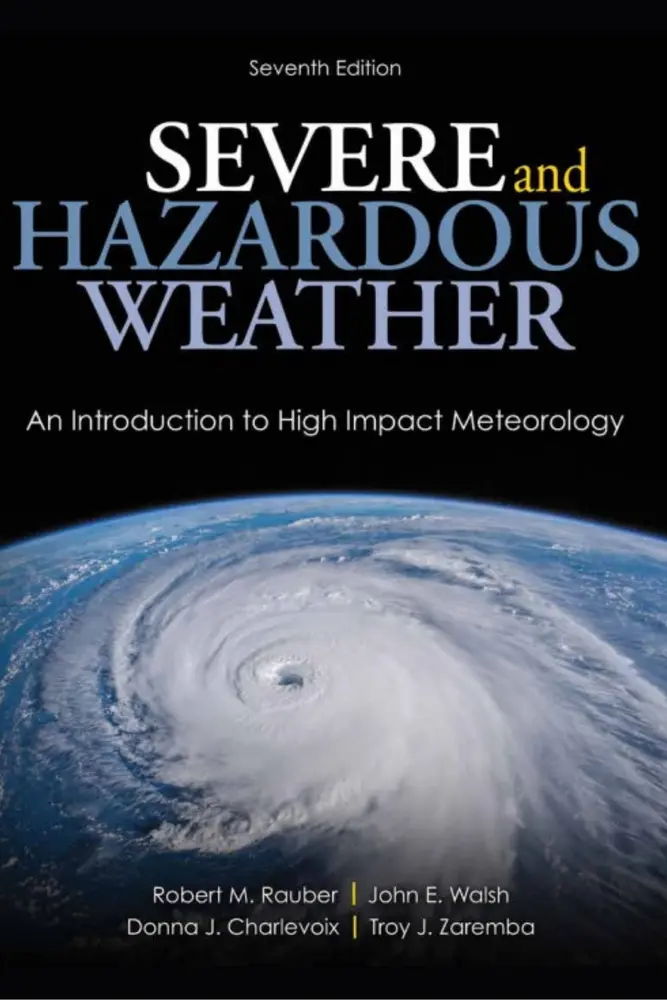
For decades, professor emeritus Bob Rauber has helped students understand some of nature’s most powerful and destructive forces. A longtime professor of the department of climate, meteorology & atmospheric sciences and former director of the School of Earth, Society and Environment at the University of Illinois Urbana-Champaign, Rauber built his career studying hazardous weather through field campaigns, radar observations, and atmospheric modeling. He is also the lead author of Severe and Hazardous Weather: An Introduction to High Impact Meteorology, a textbook originally developed for Illinois’ course of the same name, co-authored with former faculty members John Walsh and Donna Charlevoix, and now used at more than 100 colleges and universities. The newly released seventh edition reflects major advances in forecasting, research, and our understanding of extreme weather. Rauber spoke about the new edition and why studying hazardous weather remains as important as ever.
This is the seventh edition of Severe and Hazardous Weather. What motivated you and your co-authors to produce this new edition at this moment?
One of the things when you write about severe and hazardous weather is that the weather happens every year. We want to keep the events that we describe relevant to students, and events time out, so to speak. For example, Hurricane Katrina, one of the worst storms to hit the United States, happened over 20 years ago. Most of the current students in general education classes today were not born yet during Hurricane Katrina. Even though it's an important event, time marches on.
And the other thing that marches on is science. New discoveries, more sophisticated investigations of storms, better forecasting — all these are continually improving. We want to keep that relevant as well.
The third thing that's changed, mainly due to COVID, is a shift to digital textbooks in the publishing industry. In the new edition, we've developed a whole series of questions and related pedagogical material that can interface with the systems a particular university uses, making it relevant to this generation of students.
The back cover mentions the recent surge in extreme weather events. How have these events and technological developments over the past few years shaped this edition?
A lot of recent events were pretty heartbreaking, for example the LA fires and the flood on the Guadalupe River in Texas. Those are just examples of some of the horrible disasters that have occurred. Our book has been around for almost 26 years. We update every 3 to 4 years to stay relevant to what's happening in the world and to adapt to new learning styles that have emerged.
Climate change is also a major ongoing topic. We've updated a lot of the material on climate change to reflect our understanding of current warming trends and the research and evidence that are accruing for human-induced climate change. The chapter on fire weather was substantially updated due to the big fires that have erupted as the climate warms. The chapters on floods and heat waves were also updated substantially.
How is the book organized?
The book is organized by types of weather hazards. The first several chapters provide basic information that the student needs to understand for us to communicate effectively about the rest of the material —chapters on meteorological terms, measurements, forecasting, weather maps, instability, and the forces that drive larger storms.
Then we have chapters on winter weather: ice storms, lake-effect storms, mountain snowstorms, mountain windstorms, cold waves, and blizzards.
The next five chapters comprise the thunderstorm group — thunderstorms, tornadoes, lightning, hail, and downbursts. We follow that with two tropics related chapters: El Niño and hurricanes. Finally, we have chapters focusing on phenomena such as floods, droughts, heat waves, and fires.
We've designed the chapters to be independent so that instructors in different parts of the country or the world can choose chapters most relevant to them. There's more material in the book than can be taught in a course, but the instructor can tailor it to their region.
What do you think would be the most significant updates or additions in the 7th edition versus the 6th?
We have gone through every chapter, remove dated material, add new material, and particularly try to update the science. For example, in our chapter on weather forecasting, four years ago, there was no AI forecasts. Now there's an AI forecast system producing very accurate forecasts based on historical training data dating back to the 1950s. And so, we've added a section on AI forecasting. We keep up with both scientific innovation and hazardous events.
The pedagogical material has been updated substantially. What we had in the past was the textbook and a small workbook with active learning exercises. We've moved the active learning exercises online now. We had questions at the back of each chapter — we moved those online as well. The most important change was that we developed a whole new series of questions, where we've taken about 80% of the figures in the book and adapted them so that they were used as review questions.
For example, a particular figure in the book might include information. In the review question, we removed some of the information from the figure, added blank lines where the information was, and ask the student to fill in the information based on the book figure. This motivates the student to go back and look at the figure in the book again to answer the question, reinforcing the material.
The book's been used at more than like 100 universities and colleges. Why do you think it's had such staying power in atmospheric science education?
What human isn't fascinated by natural phenomena, particularly natural disasters? When you watch a hurricane on a satellite animation, or see a tornado on video, you have to look at it. They are scary but fascinating. No one wants to be involved in one. No one wants to be hit by one and lose their house or their farm or their lives. This is nature on a rampage, and it has a fascination that I think people want to learn about. People also want to protect themselves. They want to understand what to do if one of these events occurs.
I think there's an innate fascination with the weather that's part of humanity. The severe and hazardous weather course is popular for that reason. We developed the book for that course.
I started at Illinois in 1987, and at that time, we had a course, but it was not really well organized. Myself, John, and later Donna — the three authors — taught it, rotating between us. I decided in 1999 that we simply didn't have the material to teach it properly, so I said, "Let's write a book," and I asked John and Donna if they'd be willing to join in. That's how it got started. There were so many courses across the country called severe and unusual weather, severe and hazardous weather, or severe weather, yet there was no book. So we took two years and wrote it. Now in the seventh edition, we've added a fourth author, Dr. Troy Zaremba, a triple Illinois alum, and my former graduate student.
What does it mean to you to see Troy become a collaborator on the book?
Troy is just an absolutely fantastic scientist. I invited him to join the author list because I'd like to see this book continue beyond me, John, and Donna. I'm 74, so I don't know how many more editions I'm going to be good for down the line. I'd like to see the book continue, and I trust that Troy will be the person to do it. We've worked together for so many years now, and I just know he's the right person.
What do you hope students take away from this newest edition, both scientifically and practically?
Safety. I want students to understand what these hazards involve as they grow up, buy houses, and have families. They will no doubt live in some area that's threatened by hazardous weather. They need to understand safety, insurance and everything else associated with natural hazards, and the threats that they might one day have to deal with.
I also genuinely hope they develop a lifelong interest in nature and its power. To me, it's one of the most fascinating aspects of being alive. I've had my whole career revolving around weather and its hazards. I get to study what makes me cold when I walk out the door in winter, what makes me hot on a summer day, and the scary and fascinating storms that nature provides. I hope they have that same fascination, or at least develop some interest and respect for weather and its power.